If you love The Ranch at Prescott for its forest setting, custom homes, and view-oriented lots, one big question usually comes next: should you build or buy? That choice can feel exciting and complicated at the same time, especially in a neighborhood where lot conditions, HOA rules, and home style standards all shape the outcome. This guide will help you compare both paths, understand what matters most in The Ranch at Prescott, and make a more confident decision. Let’s dive in.
The Ranch at Prescott at a Glance
The Ranch at Prescott is a planned community about three miles east of downtown Prescott on roughly 1,000 acres with about 950 home sites across eight units. It backs up to Prescott National Forest and has a more nature-focused feel than a resort-style setup.
The HOA says membership is mandatory for purchasers, and the community is governed under Arizona law with recorded documents such as CC&Rs, bylaws, and architectural guidelines. The neighborhood does not have a clubhouse or pool, but it does offer a walking trail, a tennis and pickleball court, and an active social club.
That matters because choosing to build or buy here is not only about price or floor plan. It is also about understanding the recorded restrictions, review standards, and lot-specific rules that can affect what you can do with a property.
Why Build vs Buy Is Different Here
In many neighborhoods, the question is simple: do you want a new home or an existing one? In The Ranch at Prescott, the answer usually goes deeper because many available lots are hillside, cul-de-sac, or view parcels rather than easy, flat sites.
That means a build decision often includes slope, drainage, driveway design, utility access, landscaping restoration, and HOA design review. A resale purchase, on the other hand, lets you see the finished home, improvements, and site layout before you commit.
This is also a neighborhood where listing remarks may not always match the governing documents. If there is a conflict, the HOA documents and recorded restrictions should carry more weight than marketing copy.
Building in The Ranch at Prescott
What lot inventory looks like
Recent lot examples show a wide range of parcel sizes and conditions. Current examples include lots around half an acre, just over an acre, and even larger sites, with asking prices ranging from about $50,000 to $185,000 depending on size, slope, and position.
Some lots already have useful advantages, such as utilities at the roadside, city water and sewer at the street, or a cut-in driveway. In at least one case, a seller notes that the lot already has HOA approval for a custom home plan, which can be a meaningful head start.
What the HOA design rules mean
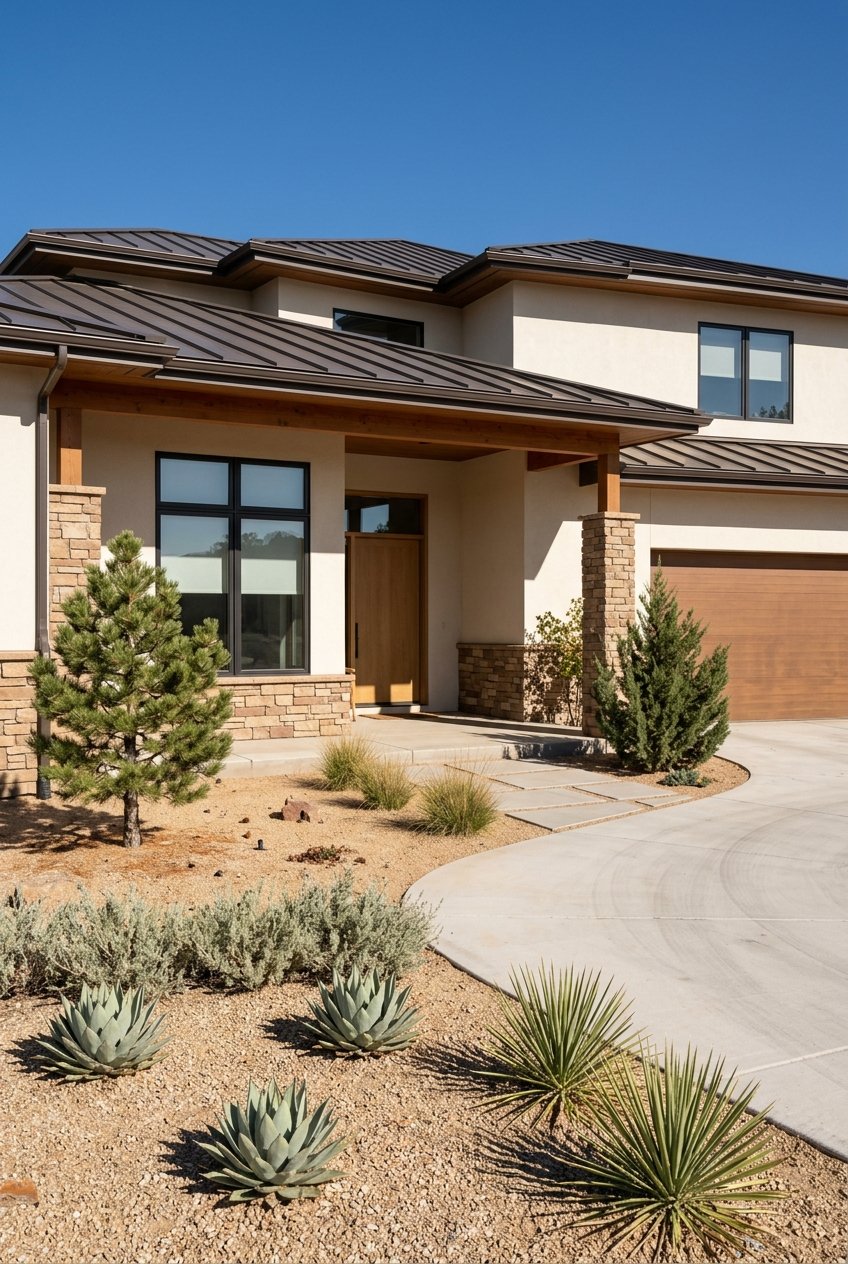
The Ranch at Prescott guidelines clearly lean toward custom homes rather than production-style construction. The design standards say homes should respond to the lot’s topography and use materials such as stucco, stone, or brick in earth-tone colors with clay or concrete tile roofing.
The guidelines also prohibit boxy production-home massing, shed roofs, detached garages, and new two-story homes. So if you are building here, you are not simply choosing a plan from a broad catalog. You need a design that fits both the neighborhood standards and the lot itself.
Minimum size and site-specific rules
Minimum square footage varies by unit. The general minimum is 2,500 square feet, Unit VII requires 3,000 square feet, and Unit IX has a different minimum.
That is why it is important to confirm the exact unit and lot number before you hire a designer or builder. Garage placement, parking, and driveway design are also controlled, and oversized RV-style garages are not allowed under the guidelines.
Slope, drainage, and landscaping matter
On a custom build, the house is only part of the total project. The HOA guidelines call out slope, drainage, vegetation, access, and view impact as site-specific variables that need careful planning.
Views are not guaranteed, and cut-and-fill work must be handled thoughtfully. Driveways and off-street parking areas must be paved and integrated with the site design, and landscaping must be restored before final inspection, which means your build budget should include more than the structure alone.
Build timeline and approval gates
A custom build here usually has three major steps: HOA architectural review, City of Prescott permitting, and construction. The City of Prescott currently reviews new single-family permits under the 2024 IRC and 2024 IBC, with 15 business days listed for the first review round and 7 business days for additional correction rounds.
The HOA also requires a final inspection before owner occupancy. On the construction side, a local Prescott design-build firm says a custom home typically takes about 10 to 16 months depending on design complexity, permitting, site work, weather, and finishes.
Who building tends to fit best
Building may be the better choice if you want control over layout, finishes, siting, and newer systems. It can also make sense if you are willing to wait longer and want to shape the home around a specific lot and view orientation.
That said, building usually works best for buyers who are comfortable with more moving parts. In this neighborhood, those moving parts often include architectural review, permit timing, earthwork, driveway planning, and post-construction landscaping.
Buying a Resale Home in The Ranch at Prescott
What the resale market shows
Homes.com portal data shows 6 active homes, an average of 70 days on market, a median sale price of $915,000 over the last 12 months, a median list price of $979,000, a median single-family sale price of $925,000, and 1.9 months of supply. Recent sold homes range from $680,000 for a 2,020-square-foot home built in 1990 to $1.7 million for a 6,190-square-foot home built in 2003.
Many newer and larger homes commonly land in the $800,000 to $1.3 million-plus range. That gives you a useful benchmark when comparing a resale purchase against the total cost of lot acquisition, design, permits, site work, and construction.
What resale buyers can compare today
Current listings show the range of finished-home options buyers may be weighing. One example is a 3,912-square-foot, two-level home listed at $925,000, while another is a 3,564-square-foot home listed at $998,000 with a level driveway and an oversized 3.5-car garage.
That context is helpful because it shows that existing homes in the neighborhood may not match today’s new-build rules exactly. In other words, resale inventory can offer features or layouts that may not be allowed for new construction now.
What appears to support value
Based on recent sold examples, value in The Ranch at Prescott appears to be supported by larger custom floor plans, view lots, a mature forest setting, and practical improvements such as pads, driveways, and garages. Newer homes have also shown strong per-square-foot pricing in some cases.
For example, one 2019-built home sold at $433 per square foot, while some older homes sold around $250 to $337 per square foot. That spread reflects how age, finish level, lot position, and improvements can all influence pricing.
Who buying resale tends to fit best
Buying a resale home often fits buyers who want a faster move, a more predictable timeline, and the ability to inspect the finished product before closing. It can reduce execution risk tied to design review, permit review, site work, and landscaping.
This path may also appeal to you if you prefer seeing the actual driveway, garage setup, interior flow, and outdoor spaces rather than trying to visualize them on paper. In a neighborhood with custom homes and varied terrain, that can be a major advantage.
A Simple Build vs Buy Comparison
| Factor |
Building |
Buying Resale |
| Timeline |
Longer, often 10 to 16 months plus approvals |
Usually faster |
| Design control |
High |
Limited to existing home |
| Site risk |
Higher due to slope, drainage, access, and landscaping |
Lower because improvements are already in place |
| Rule sensitivity |
High, due to HOA design review and unit-specific standards |
Still important, but the home already exists |
| Cost clarity |
Can change as site work and finishes evolve |
Generally easier to evaluate upfront |
| Move-in certainty |
Lower during planning and construction |
Higher after inspections and closing process |
Watch for These Due Diligence Issues
Confirm the governing documents
Before you move forward on a lot or home, confirm the current CC&Rs, bylaws, architectural guidelines, community maps, and any current assessment or budget materials available through the HOA. These documents are central to understanding what is allowed and what ownership requires.
Verify lot-specific details
If you are considering land, verify utility availability, setbacks, slope or drainage concerns, and the minimum square footage for that specific unit. Also check whether any architectural plans already have HOA approval.
Review wildfire and fire-safety items
The HOA provides fire-safety information, so it is smart to review wildfire mitigation expectations and any fire-protection requirements that may affect ownership or insurance-related planning. This is especially important in a forest-adjacent setting.
Be careful with listing remarks
Do not rely on listing copy alone if it conflicts with HOA documents or recorded rules. In the current market, examples exist where listing language suggests no HOA or says a lot can support a two-story build, even though the HOA documents indicate mandatory membership and prohibit new two-story homes.
How Many Buyers Make the Decision
A practical way to decide is to ask yourself which tradeoff matters more. Do you want the freedom to tailor the home, even if that means more time, approvals, and site work? Or do you want the certainty of seeing the finished property and moving sooner?
In The Ranch at Prescott, that choice is often less about new versus old and more about whether you want to create a home from a raw or semi-raw lot or buy a completed property that already meets the neighborhood’s custom-home standard. Both paths can work well, but they serve different priorities.
If you want help comparing lot opportunities, resale options, or the true tradeoffs between the two, Team Schneider can help you evaluate the details and make a confident move in Prescott.
FAQs
What makes building in The Ranch at Prescott different from other Prescott neighborhoods?
- Building in The Ranch at Prescott usually involves custom-home standards, hillside or view-oriented lots, HOA architectural review, and unit-specific rules that can affect design, size, and site planning.
What should you verify before buying a lot in The Ranch at Prescott?
- You should verify the lot’s unit, minimum square footage requirement, utility availability, slope and drainage conditions, setbacks, HOA guidelines, and whether any plans already have HOA approval.
What do The Ranch at Prescott HOA rules say about new home design?
- The guidelines call for custom homes that fit the lot’s topography, use earth-tone exterior materials, and follow specific rules on roof style, garage design, parking, and massing, including a prohibition on new two-story homes.
What is the typical timeline for building a custom home in The Ranch at Prescott?
- A custom build typically includes HOA review, City of Prescott permitting, and construction, with local custom-home timing often running about 10 to 16 months depending on complexity and site conditions.
Is buying a resale home in The Ranch at Prescott easier than building?
- For many buyers, yes. A resale home can offer a faster timeline, clearer upfront costs, and less risk around permits, design approval, site work, and landscaping because the home is already completed.
What price range do resale homes in The Ranch at Prescott fall into?
- Recent sold examples range from about $680,000 to $1.7 million, with many newer or larger homes commonly landing from the $800,000s into the $1.3 million-plus range.